
[DOG] [CAT] Is the Smallest Puppy or Kitten Really Doomed? (Expanded Version)
Every breeder has a name for that puppy or that kitten. The runt. The little one. The one at the back.
I have heard the story more times than I can count, on breeders' forums, at shows, over coffee after a talk. A litter of 6 with one puppy almost a third lighter than the biggest. A litter of 5 with a 70 gram kitten. And a breeder who has already, quietly, decided not to get attached. Not out of coldness. Out of experience.
I understand the instinct. We weigh at birth, and I recommend doing it as soon as the newborn has been properly resuscitated, dried and breathing well. Then the smallest number on the sheet looks like a verdict, and that is how most of us were taught to read it.
The recent research on those newborns says something different. Born light, a puppy or a kitten is in a high risk group. But the group is not fixed. Whether it stays there is largely decided in the 48 hours after birth, on a scale, and the light ones that gain over those 2 days mostly leave the risk group behind.
So the way we breed has to change with it. The question, when the litter arrives, is no longer whether the small one is worth trying. It is what the scale says on day 2. And to read that number, you need 3 things. What low means in your breed. What to do with that newborn. And what to aim for.
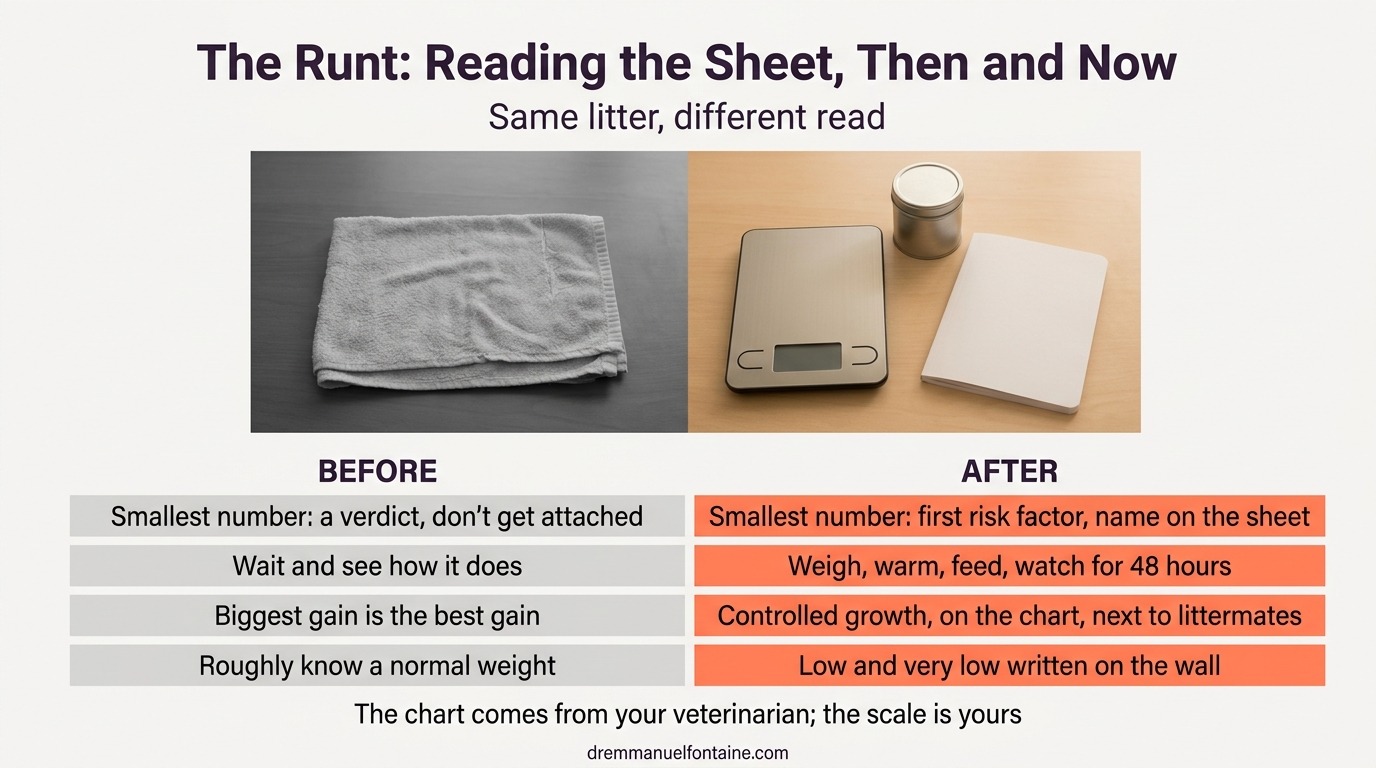
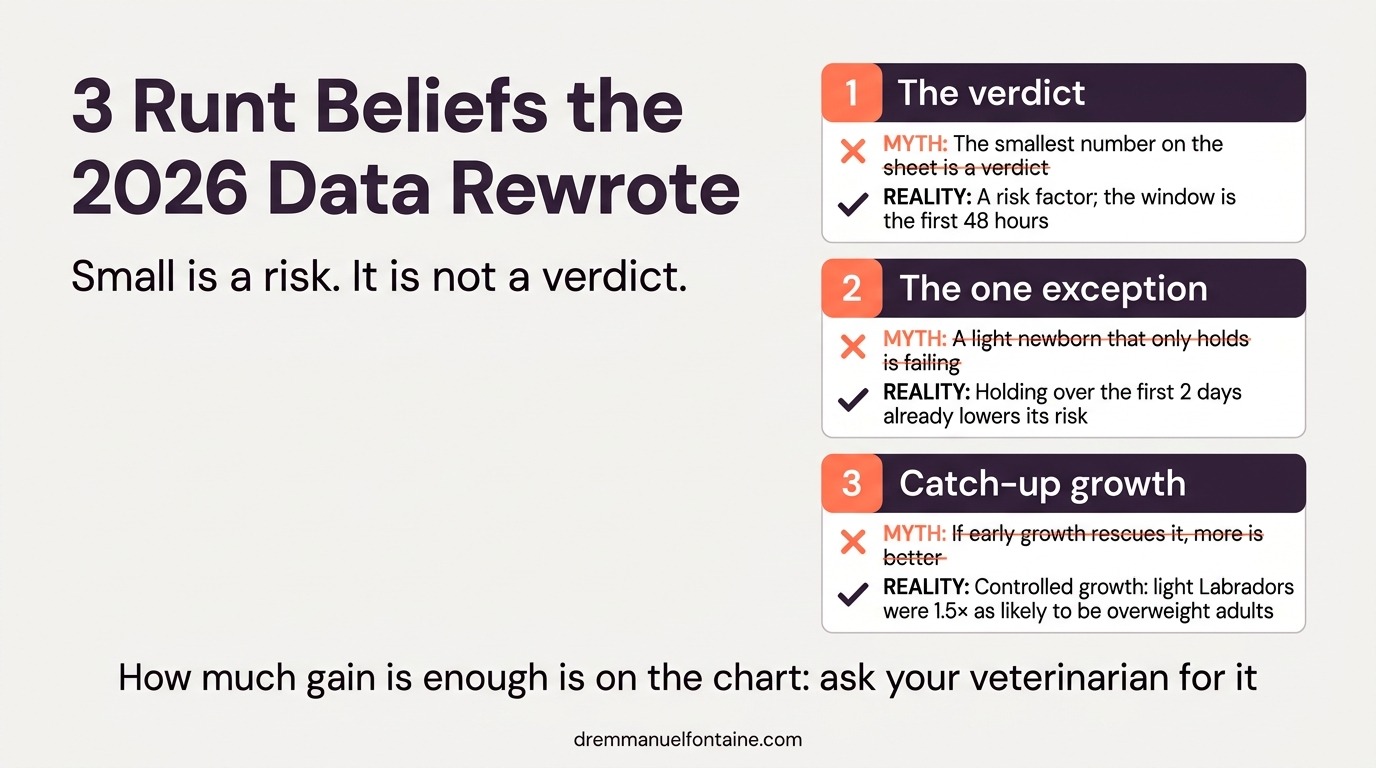
Small is a risk. It is not a verdict.
The risk is real. A 2026 review of how early life shapes a dog pulled together the survival figures of several thousand puppies from 10 breeds. Out of 100 puppies born at a normal weight, about 4 die in the first 3 weeks. Out of 100 low birth weight puppies, 11 do, nearly 3 times as many. Out of 100 very low birth weight puppies, 61 do, about 15 times as many. Kittens follow the same pattern: in a study of more than 5,500 kittens from 193 catteries, a low birth weight kitten was more than 4 times as likely to die in its first 2 months as a normal weight one.
Read those numbers as the reminder I keep giving. We need to identify the newborns at risk very early, and birth weight is the first risk factor you can read, minutes after the birth. That is why weighing every puppy and every kitten as soon as it has been resuscitated is not a nice habit in my book. It is a mandatory step. It is the moment the newborn at risk gets its name on the sheet.
Why is the light one fragile? Over their first 12 hours, low birth weight puppies suckle less often and for less time than their littermates, which points to less colostrum taken in: less energy, less immune protection. Small and cold travel together, too. A study of newborn puppies found that the smaller a puppy was relative to its mother, the cooler its ear temperature at birth, and a 2026 kitten study found that kittens from bigger litters were lighter, cooler and scored lower on their newborn vitality check. The small one is not the doomed one. The small one that is cold, not drinking and not gaining is the one that needs you the most.
Now, you could argue there is nothing new here. They are smaller, so they are more at risk. Every breeder knows that. What does all this change? This.
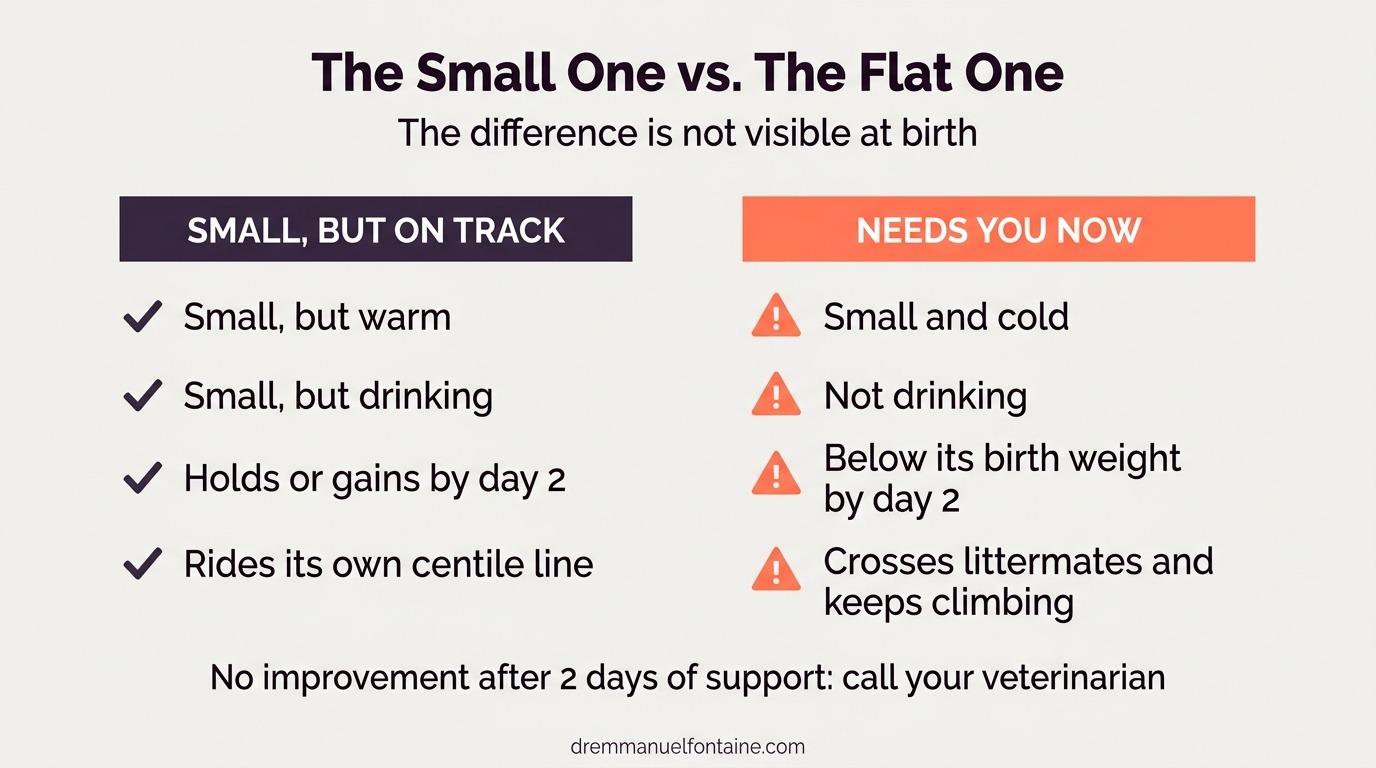
The gap closes inside 48 hours.
We used to think the light newborn's story was already written. It was small, it was weak, and the first days were simply when we found out. Look at it now. The same review followed early growth in a larger set of puppies, from 12 breeds this time, and found that low birth weight puppies that grow well over their first 2 days end up with a risk of dying over the following 3 weeks close to that of their normal weight littermates. Born light, the puppy is in a high risk group. The ones that grow over the first 2 days mostly leave it. The first 2 days were never just where the weak ones died. They are where the light ones that grow become ordinary puppies.
I used to read a low birth weight as a verdict. Not anymore. A verdict is delivered once. What these newborns face is a window, and a window can be watched.
The review also gives a floor, and it bends one of my own rules. I always say a healthy puppy gains weight every day, and I stand by it. But here is the one exception, and it works in the small one's favour: for a low birth weight puppy, simply holding its birth weight over the first 2 days already lowers its risk. So if a light puppy holds, that is a good sign. If it gains, that is even better, and gaining is what brings its risk close to normal. The goal is to do whatever we can for that puppy to gain.
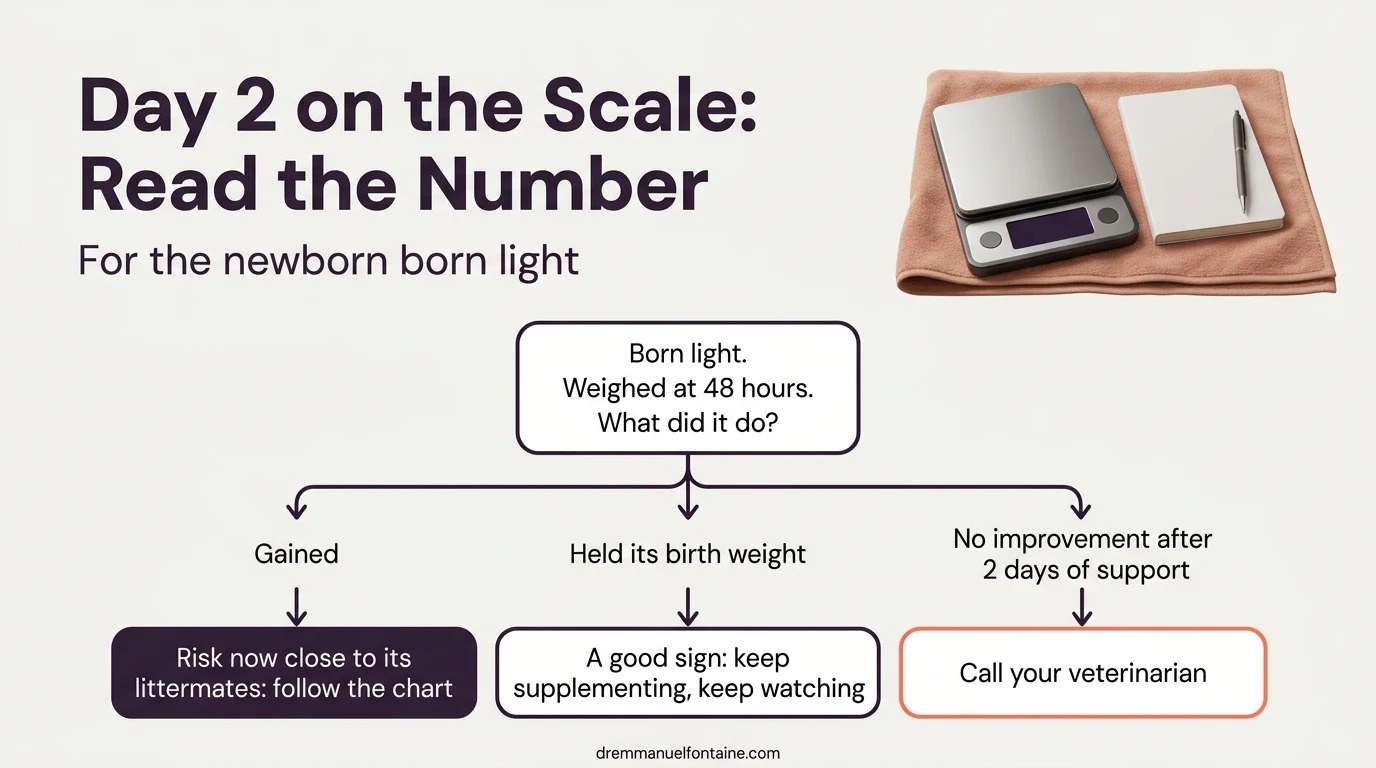
Kittens tell the same story, with one twist. For a light kitten, the study drew its line at about 10 percent above birth weight by day 2. Below that line, 28 light kittens in 100 died over the first 2 months. At or above it, 10 in 100. And the light kittens that grew faster than the slowest ones had a death rate no higher than the slowest growing normal weight kittens. The gap narrowed a lot. It did not vanish entirely, so the small kitten stays on your watch list through its first 3 weeks.
Two species, the same question, one conclusion: the sentence is not written at birth. It is written, or torn up, between the first weighing and the third.
The small one needs controlled growth. Not maximum growth.
There is a caveat, though, and it carries the concept I want you to keep: controlled growth. The obvious next thought is that if early growth rescues the small one, more must be better. It is not. In Labradors followed into adulthood, the dogs born light were 1.5 times as likely to be overweight or obese as adults. The review's authors also suspect that excessive growth in the first weeks of life adds to that risk on its own, and the kitten researchers raise the same concern: in humans and piglets, catch-up growth appears to favour fat over muscle. So the small newborn sits between 2 risks. Too little early growth, and it stays in the danger band. Too much, and we may be reinforcing the very metabolic setting that a low birth weight already installed.
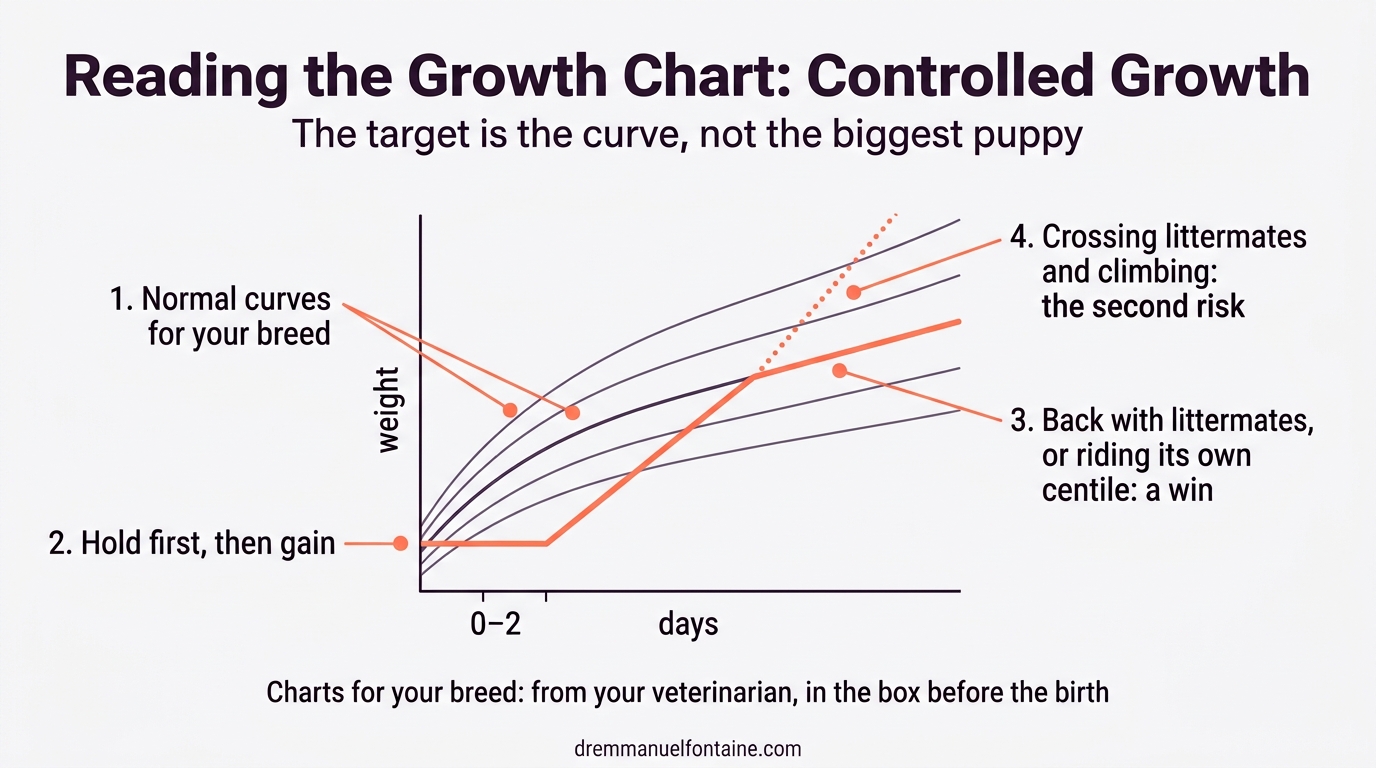
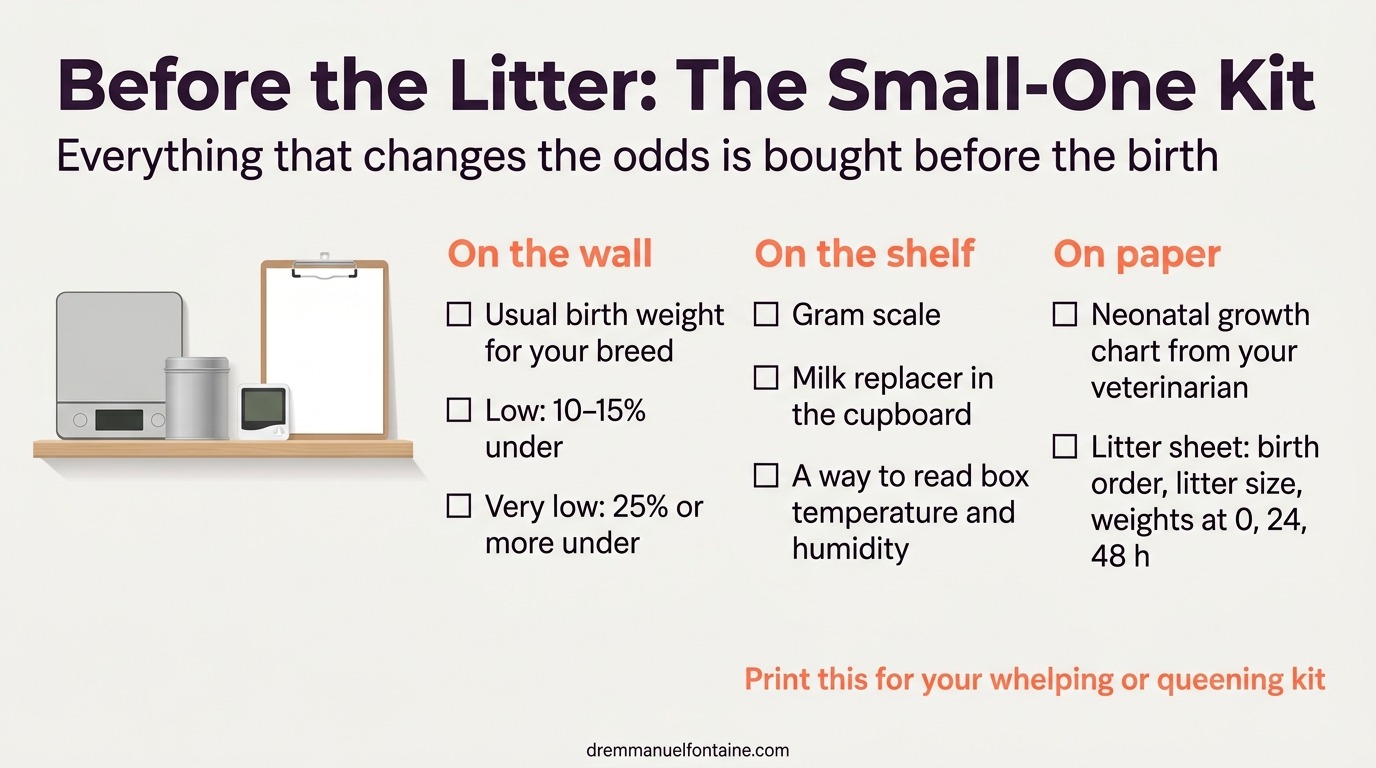
This is where the neonatal growth charts change the game, and I want every breeder reading this to have them. Talk to your veterinarian about them, and make sure they are in your whelping box or your queening room. They show what a normal curve looks like for your breed, and against them the target for a light newborn becomes clear. Over the first 2 days, hold, then gain. Over the following weeks, what I ideally want to see is that newborn back on track with its littermates. But if it settles on one centile line of the chart and follows it nicely, that is already a win in my book. What I do not want is a light puppy or kitten that crosses its littermates and keeps climbing. That is not a success story. It may be the second risk arriving.
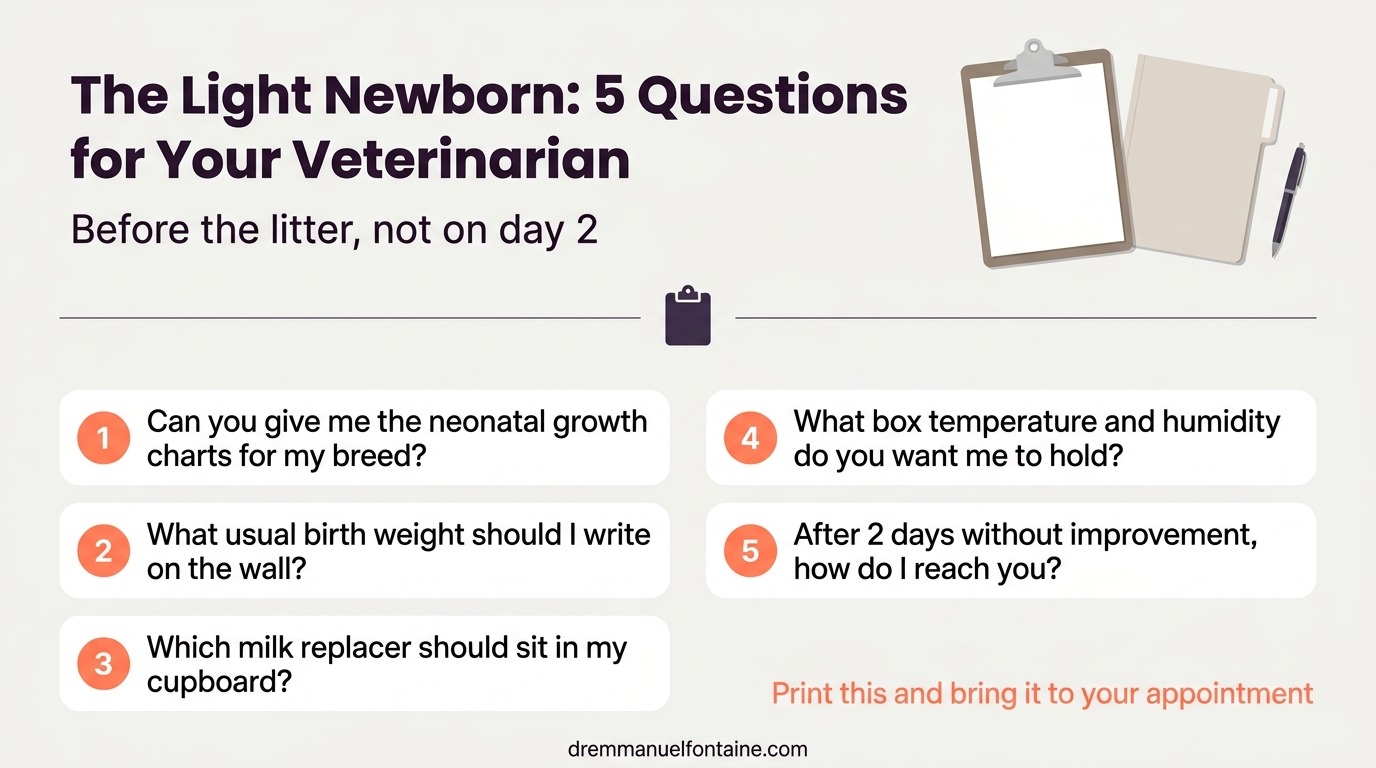
Before any of this, one prerequisite, and I consider it mandatory for a breeding program: you must know what a normal birth weight looks like for you. Not roughly. On paper, before the puppies or the kittens are born. Take the birth weights of your last few litters, or the neonatal growth charts, and find the usual birth weight for your breed. Then apply my working rule: a newborn 10 to 15 percent under that usual weight is low, and a newborn 25 percent or more under it is very low. With those 3 numbers on the wall of the whelping room or the queening room, identifying the ones at risk takes seconds, at the exact moment it matters.
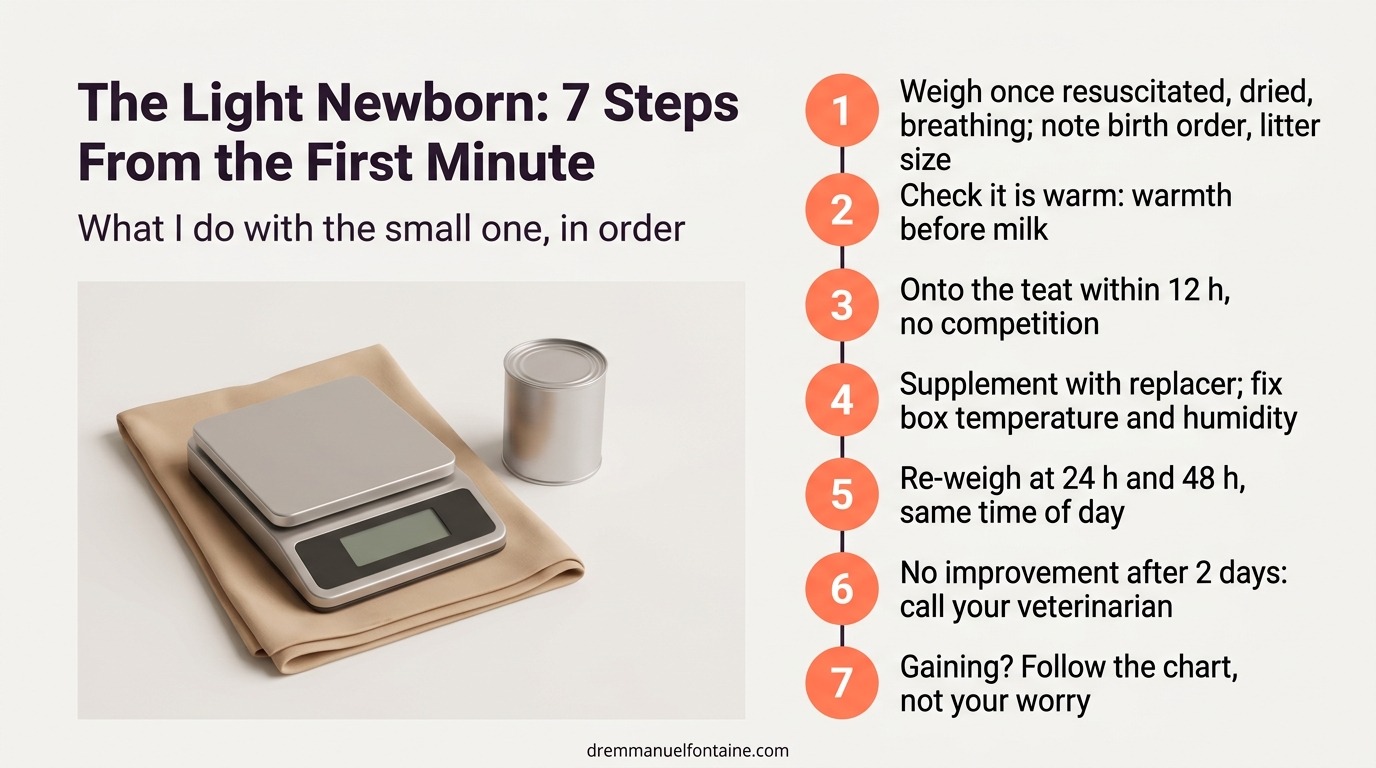
So here is what I do with a light newborn, from the first minute.
1. Weigh it as soon as it has been resuscitated, dried and is breathing well, and write the number down with its birth order and the litter size.
2. Check that it is warm. A cold newborn does not digest. Warmth comes before milk.
3. Get it onto the teat within its first 12 hours, without competition: a few minutes with the mother while the bigger ones are set aside, or your hand keeping it on the nipple. That is the colostrum window, and the light one is the one that misses it.
4. Once it is flagged at risk, it gets support on 2 fronts at once. It is supplemented with a milk replacer on top of what it takes from its mother, and its environment is optimized: temperature and humidity in the box checked and corrected, not assumed.
5. Weigh it again at 24 hours and at 48 hours, at the same time of day, against the birth weight and the chart. Holding is a good sign. Gaining is better.
6. If after 2 days of supplementing and optimizing there is still no improvement, connect with your veterinarian. That is the signal that what you are doing is not enough.
7. Once it is gaining, follow the chart, not your worry. When it is back with its littermates, or holding its own centile line nicely, the extra attention can ease off.
What I want you to take from this.
Read the sheet on day 2 with one rule. A newborn born at a normal weight must gain, every day. That is my rule, stricter than the studies' floor. Holding is not enough for that one. For the light one, holding is a good sign and gaining is the goal, and how much gain is enough is not a number to invent. It is on the growth chart, next to the littermates.
The small puppy is not the one I worry about most. The flat one is. And the difference between them is not visible at birth. It is visible on a scale, 2 days later, to anyone who looked.
Think back to how this issue started: the smallest number on the sheet, and a breeder quietly deciding not to get attached. I hope you read that number differently now. It is not a verdict. It is the first risk factor you can identify, minutes after the birth, and it tells you exactly which newborn to weigh, warm, feed and watch for the next 2 days. You know what normal looks like for your breed. You know what low and very low mean. You know that holding is good, that gaining is better, and that controlled growth is the target, not the biggest puppy or kitten in the box. You will still have small ones. You will just never again lose one by default.
Reading this as a free sample? Every Saturday newsletter has an expanded edition like this one in the Breeder Vault, alongside more than 8 hours of video lessons and more than 10 step-by-step protocols. Join the Vault (US$20/month, cancel anytime).